

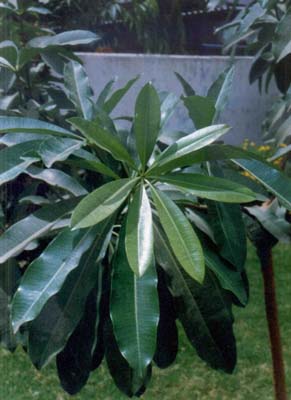
Saptaparna, Satachhada.
Common Name: Devil tree, Dita bark tree
Botanical Name: Alstonia scholaris (L.) R. Br.
Family: Apocynaceae
Medicinal Uses
Root is given for enlarged liver with pain. Bark is acrid, bitter, heating, oleaginous; appetiser, laxative, anthelmintic, galactogogue. It is good in heart diseases, Known to have properties like antibacterial (Khan et al. 2003), asthma, leucoderma, ulcers, diseases of the blood, "tridosha" pain, tumours (Kamarajan et al., 1991). According to Ayurveda, it is very good for chronic ulcers. The bark is used as an astringent tonic, antiperiodic and febrifuge; valuable in debility and after-effects of fever. It is a good remedy for chronic diarrhoea and dysentery; also useful in catarrhal fever. It is also said to be used in leprosy, stomach-ache and liver complaints. In ulcers and rheumatic pains milky juice of the plant is applied. Alkaloid ditamine is said to be equally effective as sulphate of quinine, but no definite conclusions as to its anti-malarial properties are yet found (Gandhi & Vinayak, 1990). Keawpradub et al. (1999) observed antiplasmodial activity against multidrug-resistant K1 strain of Plasmodium falciparum. Bark contains two alkaloids ditamine and achitamine. According to Koppula (1981), leaf of this plant is good in rheumatism. Krishnaswamy and Purushothaman (1983) reported anticancer activity of echitamine chloride which is an alkaloid derived from Alstonia scholaris. Keawpradub et al. (1997) reported its activity against lung cancer. The bark is used in chronic diarrhoea and dysentery and cardiac problems. Young leaves are used in the deficiency of vit-B. Dry leaves are used for skin diseases. Latex is used for ulcers and swellings. Leaves are used to kill the worm in wound (Nair et al., 1984). The bark, which appears in quills or irregular curved pieces, have bitter taste is a source of important alkaloids producing medicines against malarial problems (Gandhi & Vinayak, 1990) and chronic diarrhoea. It is also used to treat fever earache, skin diseases and destroy parasitic worm. It is also used to clean wounds.
Veterinary Uses
Bark extract is effective against bovine filarial parasite Setaria digitata (Mathai & Devi, 1992).
← Back