

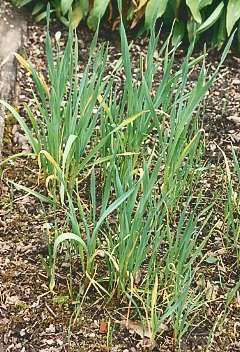
Nripakanda, palandu, raktakanda (WOA, 1998).
Common Name: Onion, Spring Onion, Shallot, Scallion
Botanical Name: Allium cepa L.
Family: Liliaceae
Medicinal Uses
It has a wide range of beneficial actions on the body and when eaten raw, it promotes the general health of the body. The underground bulb is anthelmintic, anti-inflammatory, antiseptic, antispasmodic, carminative, diuretic, expectorant, febrifuge, hypoglycaemic, hypotensive, lithontripic, stomachic and tonic (Sarma, 1984; Lata et al., 1991; Augusti, 1996). Regular use of bulb in daily meals offsets tendencies towards angina, arteriosclerosis and heart attack. It is beneficial in preventing oral infection and tooth decay. Bulbs baked and directly applied as a poultice to remove pus from sores. Fresh onion juice seems to be useful in bee and wasp stings, bites, grazes or fungal skin complaints. As a home remedy, warm juice can be dropped into the ear to treat earache. It is also helpful in healing process of wounds. Mature bulbs of red cultivars are used to make a homeopathic remedy for the treatment of people whose symptoms include running eyes and nose.
Veterinary Uses
Mixture of kallathikai (Ficus tinctoria), 50 g cumin and two onion can be used to relieve asthma and cough in animals (Anonymous, 2000-2001). Mixture of whey milk, onion and leaves of `Sitafal' (Annona squamosa) is given to the animal suffering from flatulence. The suspension of onion and turmeric powder mixed in equal quantity in whey milk is given to the animals for controlling flatulence (Deddu, 1992). Mixture of `Ajma' (100 g), onion (200 g) and aerial root of banyan tree (Ficus benghalensis) is fed to the animal for controlling flatulence (,Rathod, 1992). Approximately 200 gm of pounded mixture of small pieces of `Kund' (Scilla spp.) tuber and bulb of onion is given to the animal to control flatulence (Deddu, 1992). As a treatment for a disease that causes inactivity in chickens, onion and garlic bulbs are pounded together with the vine of `Amarvel' (Cuscuta reflexa) and this mixture is added to the birds' drinking water. Mortality rate is reduced considerably (Patel, 1992). Small pieces of onion is pounded and mixed in drinking water of birds kept for egg to prevent the unknown disease that causes death. Fermentation dicoction made from the storage tissue of Withania somnifera, leaves of Gynandropsis pentaphylla, stem of Cissus quadrangularis, white onion, pepper and ginger mixed with the same quantity of buttermilk. A litre of this mixture is given to the affected animal to cure asthma (Anonymous, 1997). The ashes obtained by burning onion peels are mixed with some butter, and the paste is applied to the yolk gall of the bullock (Vasnoi, 1997). To cure the intestinal worms in bullock, 250 g white onion is fed for a week, along with 'rati bhindi' or sesame (Chauhan, 1994). Diarrhoea in poultry birds can be controlled by feeding onion juice (Anonymous, 1998). Stems of Cissus quadrangularis, cumin seeds, capsicum fruits, onion and rhizomes of Solena amplexicaulis are ground and the mixture soaked in water for a day. This mixture is then administered to cattle for three days to increase their body weight. Five pods of kachakamutty, leaves of veeli, seeds of pepper and black cumin, leaves of betel, and onion bulbs are crushed and made into a solution. This solution is fed to cure tail hair drop and skin rashes in cattle (Anonymous, 1995). Steamed and crushed onion is used for neck swelling in cattle (Anonymous, 1994). Five hundred gram of Pirandai (Vitis quadrangularis), 25g dried chilli, 5g Sea gram (Cuminum cyminum) and 100 g of small onion are pounded together and given as bolus to control worm infestation in cattle (Ithal, 1998). Animals having the history of prolapsed uterus are fed with 10 kgs of onion to avert the danger during delivery (Rathod, 1999). Onion, garlic, jeera, turmeric, chilli and salt are used along with about 25-30 leaves of Premna obtusifolia soaked in about 10-15 litres of buttermilk to perform pseudo delivery system in some cows which desist feeding the calf (Rathod, 1999).
← Back